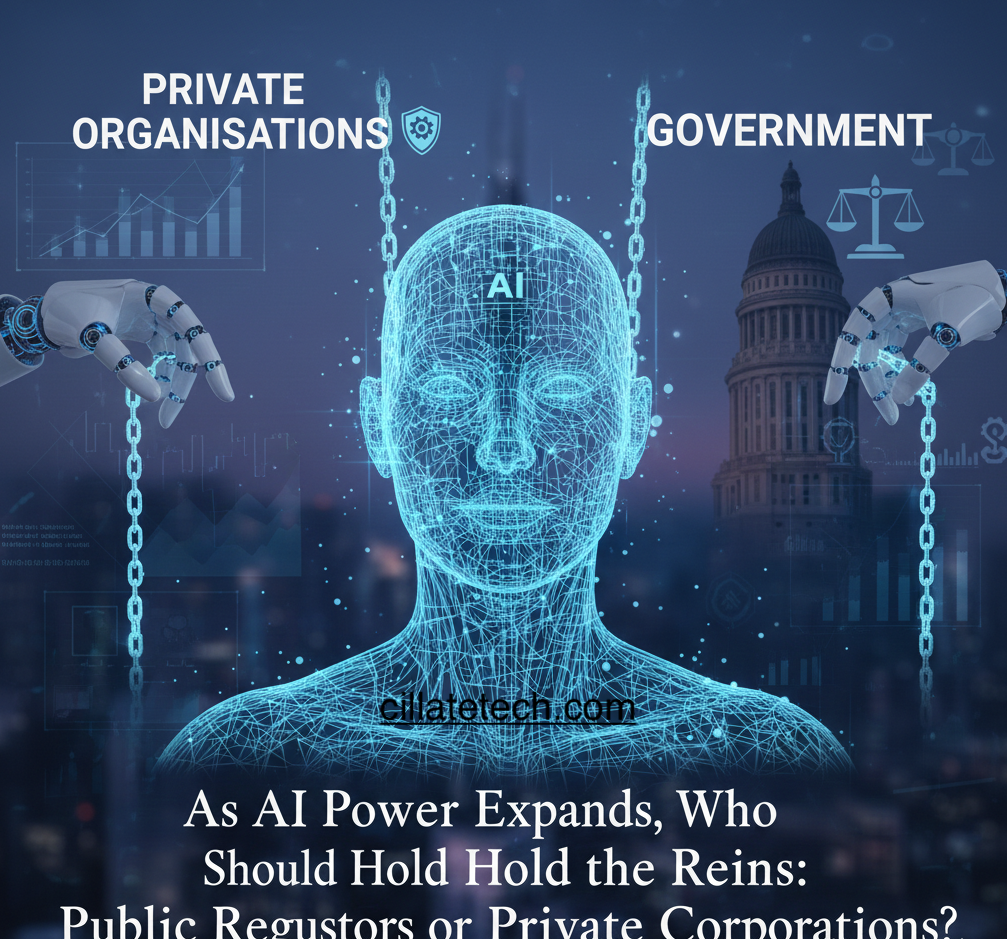
Artificial intelligence (AI) is no longer a futuristic concept—it is an active force reshaping industries, economies, and societies at an unprecedented pace. From generative models that produce text, images, and code to autonomous systems managing logistics, finance, and healthcare, AI is transforming how work gets done and how decisions are made. This rapid expansion of AI capabilities brings enormous opportunities, but also serious challenges. As AI becomes more sophisticated, a critical question arises: who should oversee this powerful technology—public regulators entrusted with societal interests, or private corporations driving innovation?
The answer is far from simple. Both sides have distinct advantages and limitations, and the consequences of leaving AI governance to one party alone could be significant. This article explores the debate in depth, examines real-world examples, and proposes a pathway toward responsible, collaborative AI oversight.
The Need for Oversight in the Age of AI
AI systems are no longer experimental tools confined to research labs. They are deployed at scale, influencing decisions that affect millions of people. Automated hiring systems, credit scoring algorithms, autonomous vehicles, and recommendation engines can directly impact individuals’ livelihoods, privacy, and safety. As such, oversight is not optional—it is essential.
Public regulators are traditionally tasked with protecting citizens, ensuring fairness, and enforcing standards that serve the broader society. Their involvement in AI governance is critical because AI has implications far beyond individual organizations. Decisions made by private companies can ripple across industries and geographies, affecting public safety, access to opportunities, and societal equity. At the same time, private corporations possess technical expertise, operational agility, and global reach that regulators often lack. Without careful coordination, governance could either stifle innovation or allow unsafe practices to flourish.
The challenge, therefore, is to find a balance between accountability, innovation, and ethical responsibility.
Public Regulation: Safeguarding Society
Proponents of public oversight argue that governments are uniquely positioned to ensure that AI serves the public good. Regulators can create legal frameworks that enforce safety standards, transparency, and ethical conduct. By establishing rules for accountability, governments can ensure that organizations deploying AI are held responsible for errors, biases, or unintended consequences.
Beyond safety, public regulation can provide ethical oversight. AI systems, if left unchecked, may reinforce discrimination, invade privacy, or manipulate human behavior. Governments can set societal standards that require fairness, inclusivity, and respect for human rights, offering protections that corporations might deprioritize in pursuit of profits. Regulation can also help ensure market fairness. By setting clear rules, governments can prevent monopolistic control over AI technologies and foster competition, creating an environment where smaller companies and startups have a fair chance to innovate.
Additionally, public oversight allows for global coordination. Many AI applications, from autonomous vehicles to cybersecurity systems, operate across borders. Governments can negotiate international agreements and standards, ensuring that AI development and deployment do not create conflicts or unsafe practices in different regions.
However, relying solely on public regulation comes with limitations. Regulatory processes are often slow and bureaucratic, which can impede the rapid innovation AI demands. Agencies may lack sufficient technical expertise to fully understand complex AI models, algorithms, and emerging risks. Overly prescriptive rules can inadvertently stifle innovation or create regulatory loopholes that companies exploit. This highlights the need for a governance model that balances caution with flexibility.
Corporate Leadership: Driving Innovation
Private corporations play a pivotal role in AI development. They possess the engineers, data scientists, and infrastructure required to design, train, and deploy cutting-edge AI systems. Corporations are often the first to experiment with new models, implement automation at scale, and discover novel applications that can transform entire industries.
One of the main advantages of corporate-led AI governance is speed. Companies can iterate quickly, adapting their systems and strategies in real-time, whereas government agencies may require months or even years to draft and enforce regulations. Corporations also bring technical expertise that is often difficult for public regulators to match. Understanding the nuances of deep learning architectures, reinforcement learning, or large-scale generative models requires highly specialized knowledge, which is concentrated within the private sector.
In addition, private firms have the operational capacity to manage AI deployment globally. Multinational companies can scale AI systems across multiple markets efficiently, responding to local requirements and customer needs. Flexibility is another advantage; private organizations can experiment, adapt, and pivot their AI strategies without the delays inherent in formal regulatory approval processes. This agility can be essential in highly competitive markets where the pace of innovation determines survival.
Yet, corporate-led oversight carries significant risks. Profit motives can overshadow ethical considerations, and companies may prioritize growth over public safety. A lack of external accountability can lead to opaque decision-making, conflicts of interest, and reduced transparency. Moreover, concentration of power in a handful of corporations raises concerns about monopolistic control over AI, with the potential to exacerbate inequality and limit access to technological benefits.
The Dangers of Single-Sided Oversight
Relying exclusively on either public regulation or private corporations has drawbacks.
If public regulators alone control AI, innovation could be slowed considerably. Overly strict rules or delayed approvals may prevent beneficial technologies from reaching society promptly. Governments may also lack the technical expertise to fully grasp the risks and capabilities of advanced AI systems, resulting in gaps in oversight. Bureaucracy can further hinder responsive governance, leaving emerging AI threats unaddressed until they escalate.
Conversely, leaving AI governance entirely to corporations risks prioritizing profits over people. Ethical considerations may be secondary to shareholder returns, and decision-making may favor competitive advantage rather than public interest. Concentration of AI expertise and deployment in a small number of companies could create monopolies, limit market diversity, and reduce transparency. Without meaningful external oversight, corporations may face minimal accountability for errors, biases, or misuse of AI systems.
Toward a Collaborative Model of Governance
Given the risks on both sides, a hybrid approach is emerging as the most practical solution. A cooperative model that combines public oversight with corporate responsibility can harness the strengths of both sectors while mitigating their weaknesses.
In such a framework, regulatory bodies and corporations work together to define standards for AI safety, ethics, and transparency. Independent audits by third parties can validate these standards, ensuring accountability without stifling innovation. Regulations should be adaptive, evolving in response to technological advancements rather than remaining rigid. Public-private partnerships can fund research into safe AI practices, ethical guidelines, and global standards. Input from academia, civil society, and the general public ensures that diverse perspectives inform policy, preventing a narrow focus on corporate or governmental interests alone.
This collaborative model balances speed and expertise with accountability and public trust. By sharing governance responsibilities, corporations can continue to innovate while governments safeguard ethical standards and societal welfare.
Lessons from Real-World Examples
Several initiatives highlight how shared responsibility can work in practice. The European Union’s AI Act, for instance, establishes a risk-based framework that combines legal enforcement with industry consultation. It categorizes AI applications based on potential harm, creating stricter rules for high-risk systems while allowing more flexibility for low-risk innovations.
Leading tech corporations have also formed internal AI ethics boards to review development and deployment processes. While the effectiveness of these boards depends on their independence and transparency, they demonstrate how private companies can take proactive responsibility for ethical AI governance.
Global multi-stakeholder initiatives, such as UNESCO’s AI guidelines, illustrate how collaboration between governments, corporations, and civil society can produce meaningful standards. These examples show that joint governance is not just theoretical—it is already being tested and refined across regions and industries.
The Path Forward
AI is rapidly becoming one of the most transformative technologies in human history. Its potential benefits are enormous, but so are the risks if left unchecked. The debate over who should govern AI—public regulators or private corporations—cannot be resolved by favoring one side exclusively. Both are essential: governments provide ethical oversight, accountability, and public protection, while corporations bring expertise, innovation, and agility.
The future of AI governance will depend on transparency, collaboration, and adaptability. Shared oversight, rigorous auditing, and inclusive stakeholder engagement will ensure that AI serves society responsibly, ethically, and equitably. By working together, regulators and corporations can harness AI’s power without sacrificing safety, fairness, or public trust.
Key Insight: The reins of AI should not rest entirely in public hands or private hands. Effective governance requires a partnership, combining the best of regulation, corporate responsibility, and societal input to steer AI toward beneficial outcomes for all.