A New Challenger to Humanity’s Oldest Institution
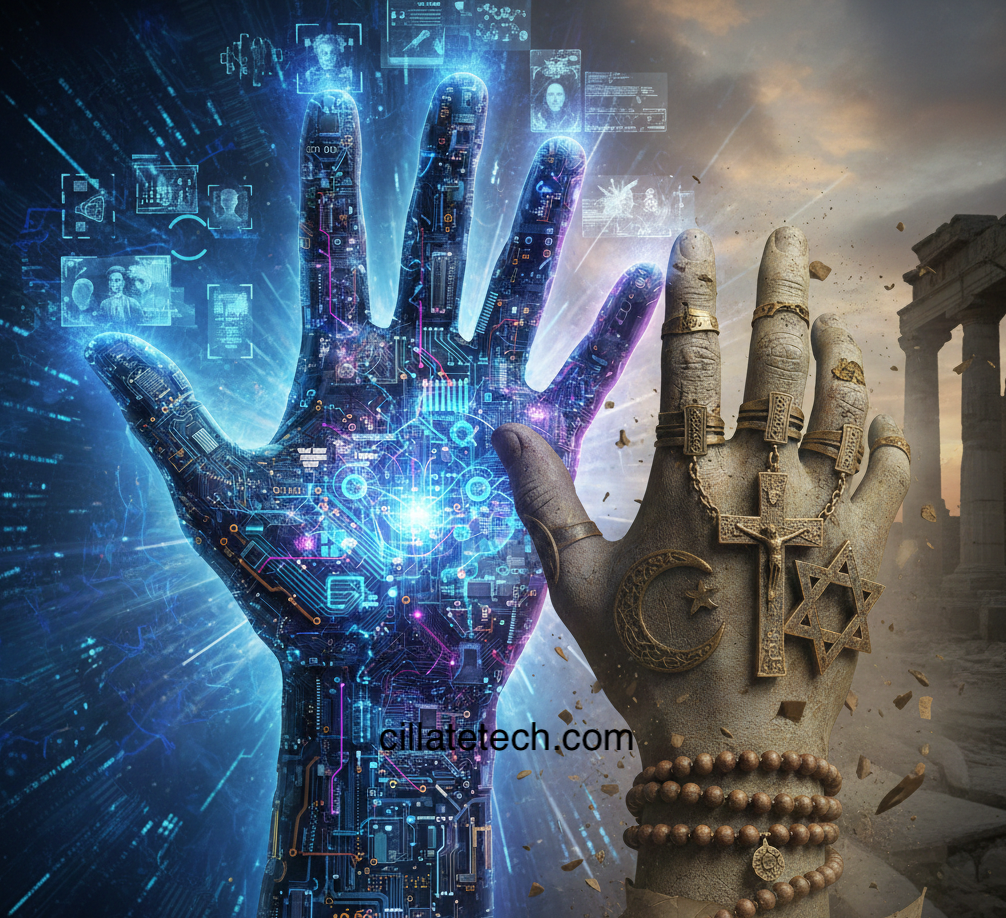
Throughout history, religion has been one of humanity’s most powerful forces. It has shaped civilizations, defined moral systems, explained the unknown, and offered comfort in the face of suffering and death. Today, however, a radically different force is rising—artificial intelligence. As AI becomes more embedded in daily life, its influence is no longer limited to science, business, or governance. It is now entering the deeply personal realm of belief and meaning.
Historian and philosopher Yuval Noah Harari has famously suggested that “AI is taking over religion.” This statement has sparked widespread debate, admiration, and concern. While controversial, the idea points to a deeper reality: AI is beginning to perform functions that religions have traditionally fulfilled—interpreting the world, guiding behavior, and offering frameworks for decision-making.
This article explores what Harari’s statement truly means, how AI is reshaping religious life, and whether faith can maintain its relevance in an age increasingly governed by algorithms.
Interpreting the Claim: What Does “AI Is Taking Over Religion” Really Mean?
A Shift in Authority, Not the Death of Belief
When Yuval Noah Harari speaks about AI taking over religion, he is not arguing that people will start worshipping machines or abandon God entirely. Instead, he highlights a transfer of authority. For centuries, humans relied on religious traditions to answer questions such as:
- What is right and wrong?
- How should I live my life?
- What gives existence meaning?
In the modern world, these questions are increasingly answered by data, algorithms, and predictive systems. When people trust AI to guide choices—about relationships, health, ethics, or even purpose—technology begins to occupy the same psychological and social space that religion once did.
The Growing Presence of AI in Religious Practice
Artificial Intelligence as a Religious Tool
Across the globe, religious institutions are experimenting with AI-driven technologies. These include:
- Automated sermon drafting tools
- AI-assisted prayer and meditation apps
- Intelligent systems for scripture translation and analysis
Supporters argue that these tools help preserve traditions, reach broader audiences, and adapt faith to modern realities. AI enables religious content to be delivered faster, more efficiently, and in more languages than ever before.
However, critics question whether spiritual messages generated by machines—without belief, reverence, or intention—can carry the same weight as those created through human faith and experience.
Virtual Clergy and AI Spiritual Advisors
One of the most striking developments is the emergence of AI-based spiritual advisors. These systems respond to users seeking guidance on moral dilemmas, emotional distress, or existential questions.
Their appeal is clear:
- Available at all times
- Free from judgment
- Personalized to the individual
Yet this convenience raises serious concerns. Religious guidance has traditionally involved accountability, communal responsibility, and human compassion. When AI replaces these interactions, spiritual life risks becoming isolated, transactional, and emotionally shallow.
Why AI Feels Like a Religious Force
Data as the New Source of Meaning
Yuval Noah Harari has long argued that modern societies are moving toward data-driven worldviews, where information processing replaces belief as the primary way humans understand reality. In this sense, AI functions similarly to religion by:
- Explaining how the world works
- Predicting outcomes
- Guiding behavior
As people increasingly trust algorithms over sacred texts or spiritual leaders, AI begins to act as a new interpretive authority.
Declining Trust in Religious Institutions
Another factor contributing to this shift is the declining credibility of traditional religious institutions in many parts of the world. Scandals, political entanglements, and rigid doctrines have pushed many individuals away from organized religion.
In contrast, AI is often perceived as:
- Objective
- Efficient
- Free from emotion or bias
This perception—whether accurate or not—has made AI an attractive alternative source of guidance.
Personalization, Algorithms, and the Reinvention of Faith
Customized Spirituality Through Technology
AI thrives on personalization. Religious platforms now offer tailored experiences based on user behavior, preferences, and emotional states. This includes:
- Personalized prayer recommendations
- Customized spiritual routines
- Algorithm-driven religious content feeds
While this makes faith more accessible, it also fragments collective belief. Religion has traditionally been communal, shared, and sometimes uncomfortable. Algorithmic spirituality, by contrast, prioritizes comfort and confirmation, potentially weakening moral challenge and shared identity.
Theological Questions AI Forces Religion to Confront
Can a Machine Engage With the Sacred?
From a theological perspective, most religions maintain that spirituality requires consciousness, intentionality, and a connection to the transcendent. AI possesses none of these qualities. It does not believe, doubt, repent, or hope.
This leads many theologians to assert that AI can assist religious practice but cannot replace genuine spiritual experience. A prayer generated by an algorithm may resemble faith, but it does not originate from belief.
Ethical Risks and Manipulation
AI systems are not neutral. They are trained on human-generated data, which can include bias, ideology, and misinformation. In a religious context, this creates dangerous possibilities:
- Distorted interpretations of sacred texts
- Reinforcement of extremist beliefs
- Use of AI to manipulate faith for political or commercial gain
Without strong ethical oversight, AI could reshape belief systems in subtle but profound ways.
Why Some Faith Leaders Embrace AI
Expanding Reach and Accessibility
Despite legitimate concerns, many religious leaders view AI as a valuable ally. AI can:
- Bring religious education to remote areas
- Assist individuals with disabilities
- Provide access to spiritual resources where clergy are unavailable
In this sense, AI serves as an instrument, not a replacement, for faith.
Promoting Interfaith Awareness
AI’s capacity to analyze multiple religious traditions allows it to highlight shared values such as compassion, justice, and humility. This opens the door to:
- Greater interfaith dialogue
- Reduced sectarian conflict
- A more global ethical framework
Is AI Replacing Religion or Redefining It?
Transformation Rather Than Elimination
Despite alarming headlines, religion is not disappearing. Instead, it is undergoing adaptation. AI is changing how people engage with belief, but it cannot replace the deeply human need for transcendence, belonging, and meaning.
Yuval Noah Harari’s claim that AI is taking over religion serves as a warning: if humans outsource moral and existential questions entirely to machines, they risk losing agency over their values.
The Future of Faith in an AI-Dominated World
As AI continues to evolve, religious communities will face critical decisions:
- How much authority should technology hold?
- Where should boundaries be drawn?
- How can faith remain meaningful without rejecting progress?
The future likely lies in balance—where AI supports education and access, while humans remain the guardians of meaning, morality, and belief.
Why Harari’s Statement Still Resonate
The idea that “AI is taking over religion,” as articulated by Yuval Noah Harari, captures a defining tension of the modern age. It is not a declaration of the end of faith, but a challenge to humanity to reflect on where it places trust and authority.
AI can calculate, predict, and optimize—but it cannot experience awe, love, guilt, or transcendence. In an era shaped by intelligent machines, the survival of religion depends not on resisting technology, but on reaffirming the uniquely human dimensions of belief.